Tribil Inferiore (or Dolenji Tarbij) is a tiny village in north-eastern Italy, less than 1 km from the border with Slovenia. Versione italiana
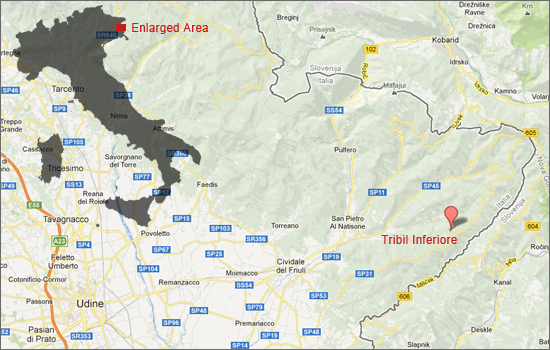
The place name Tarbij derives from the Slovenian trebiti (to clear land, to deforest) and is linked to the agricultural exploitation of the territory during the period of Slovenian colonisation of the Natisone valleys. In the municipality of Stregna we find the villages of Tribil Inferiore (Lower Tribil) and Tribil Superiore (Upper Tribil), located about 4.5 km apart, on the gently undulating ridge that starts at the foot of Mount Kum and extends to the sanctuary of Castelmonte. The village of Tribil Inferiore (588 m above sea level) sits at the centre of this landscape.
The settlement is made up of buildings densely grouped in the central part of the village and more scattered towards its outer edge. The surrounding land once held numerous mulberry trees, some centuries-old specimens of which have survived to this day.
Of particular interest is a group of eighteenth-century courtyard buildings at the heart of the village, recently restored. The complex consists of a main linear block with an external stone staircase and a long wooden gallery on the outer facade, a second linear block with a gallery facing the courtyard, and a simpler third unit that closes the courtyard.
A linear building at the southern end of the village is the most significant in Tribil: almost entirely intact in its final form, it was built by the addition of three construction phases from different periods. The downhill facade is marked by small windows; the uphill facade features an external stone staircase and a long gallery sheltered by the overhanging eaves.
Several elements of the construction reveal exceptional craftsmanship: the perfectly laid dry-stone walls, the stone door frames with arched lintels for load distribution, the polychrome diamond-patterned tiles beneath the roof, and the wooden balustrade of the gallery.
A constant feature of all the village buildings is the masterful quality of the stonework, a result of the excellent local quarrying tradition combined with the long-standing craft of the village stonemasons.
Text by the Province of Udine — sign at the village entrance.