Some thoughts on how propaganda works, and on why nobody is immune to it. — Versione italiana — Version française
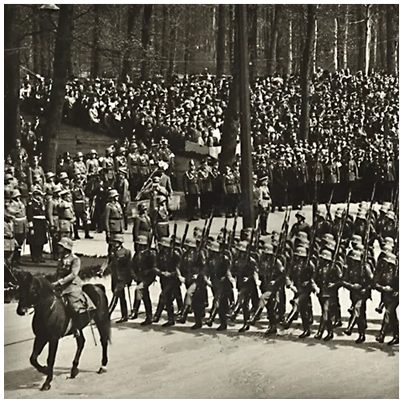
Berlin, Wehrmacht parade. Postcard from the 1930s.
How easy is it to be taken in by propaganda? Very easy. All it takes is seeing the same things and hearing the same ideas over and over: little by little, you become part of them. You can end up believing the version of events of a government, a party or a TV channel without being naive. And from there it is a short step to the worst mistake of all: taking one part of the story for the whole truth.
Two different mechanisms are at work behind this, and the philosopher C. Thi Nguyen has drawn a careful line between them. They are worth telling apart, because they are fought in different ways.
The epistemic bubble
Epistêmê is Greek for knowledge. An epistemic bubble forms when, within our network of information, some voices and some perspectives are systematically left out. We do not reject them: they simply never reach us.
It happens naturally. We follow people who think like us, we spend time in circles that share our beliefs, we read sources that resemble one another. Social media algorithms do the rest, showing us more and more of what we already liked.
The good news is that a bubble is fragile: all it takes is for the missing information to get in, and it starts to crack.
The echo chamber
An echo chamber is something else. Here outside voices are not missing: they are there, but they have been discredited in advance. Those inside learn that anyone outside is unreliable, bought, acting in bad faith.
The result is a genuine hierarchy of credibility: we trust some sources and distrust all the others as a matter of principle. What matters is no longer what is said, but who says it.
Why evidence is not enough
That is why an echo chamber is far sturdier than a bubble. Bringing in evidence from outside often does nothing, and may even reinforce it: if the source is “the enemy”, the evidence becomes proof that the enemy is lying.
This explains why some people seem immune to evidence. They are not necessarily irrational or enemies of the truth: inside an echo chamber it is the mechanisms of trust that have been manipulated, and even a careful thinker can go astray.
How to get out
The first step is both the simplest and the hardest: going out and looking. Not relying on a single channel, and sometimes getting your news from the other side too, even from “the enemy”.
In extreme cases Nguyen suggests a kind of social-epistemic reboot: suspending your beliefs and the trust you place in your usual sources, then rebuilding from scratch, without prejudice, as complete a picture as possible.
Opening up to complexity
The opening picture is a postcard from 1930s Berlin, when propaganda learned to stage strength and mass consent. Since then the means have changed a great deal, the techniques far less. Everyone has their “right” source, and whoever follows it every day is convinced they are on the right side. Nobody is immune, starting with me.
That is why, in my view, the best defence is to open up to complexity: to accept that reality rarely sits entirely on one side, and to distrust above all the simple answers that tell us we were right.
Sources
This article also grew out of an exchange on TikTok between Bianca (@biancaiannu) and Irene Lo Faro, a philosopher of language (@aka_spritz): the first told how she had got caught up in Chinese propaganda, the second explained why it can happen to anyone.
The distinction between epistemic bubbles and echo chambers comes from C. Thi Nguyen, Echo Chambers and Epistemic Bubbles, Episteme, vol. 17, no. 2, 2020, pp. 141–161.
— R.D.B., November 2026